Calculators
How to Calculate SaaS Pricing: A Practical Guide with Examples
Learn how to calculate SaaS pricing using monthly operating costs, paying customers, and target profit margins. This practical guide explains SaaS cost estimation, pricing formulas, real-world examples, common mistakes, and how to use a free SaaS pricing calculator to estimate a sustainable subscription price.
Setting the right price for a Software as a Service (SaaS) product is one of the most important decisions for a subscription-based business. If your price is too low, your subscription revenue may not cover operating costs, customer support, infrastructure, and future development. If your price is too high, potential customers may hesitate to subscribe or choose another solution.
So, how do you calculate SaaS pricing in a way that supports your business costs while leaving room for profit?
A practical starting point is to calculate your monthly operating costs, understand how many paying customers share those costs, and decide what profit margin you want to achieve. This approach gives you a cost-based pricing estimate that you can use as a starting point before considering customer value, competitors, and market demand.
In this guide, you'll learn how SaaS pricing works, which expenses to include, how to estimate the cost per customer, and how to use a SaaS pricing calculator to explore different pricing scenarios.
What Is SaaS Pricing?
SaaS pricing is the amount a customer pays to access software delivered through the internet, usually through a recurring subscription.
Unlike traditional software that may involve a one-time purchase, SaaS products commonly use monthly or annual subscriptions. Customers pay for continued access to features, hosting, updates, maintenance, and support.
Common SaaS pricing models include:
- Flat-rate pricing: Every customer pays the same subscription price for the same product or plan.
- Tiered pricing: Customers choose between plans with different features, limits, or levels of service.
- Per-user pricing: The subscription cost depends on the number of users or seats.
- Usage-based pricing: Customers pay according to how much they use the product.
- Freemium pricing: A basic version is available for free, while advanced features require a paid subscription.
- Hybrid pricing: The business combines a base subscription with usage, user, or feature-based charges.
The right model depends on your product, customers, costs, and the value your software provides.
Why Is Calculating SaaS Pricing Important?
A SaaS business needs enough recurring revenue to cover its ongoing expenses and support long-term operations.
Choosing a subscription price without understanding your costs can create problems. You might attract customers but still struggle to cover hosting, development, payment processing, customer support, and other expenses.
A structured SaaS cost estimate helps you:
- Understand the minimum revenue needed to support your operations.
- Estimate how much each paying customer needs to contribute.
- Set a target profit margin.
- Compare different subscription pricing scenarios.
- Identify whether your current customer base can support your operating costs.
- Make more informed decisions when changing subscription prices.
Cost-based calculations are especially useful for early-stage SaaS businesses that need a starting point for evaluating their subscription prices.
However, covering costs is not the same as finding the ideal market price. Your final price should also reflect the value customers receive and what they are willing to pay.
What Costs Should You Include When Calculating SaaS Pricing?
Before setting a subscription price, identify the expenses required to operate your software business.
Your estimate should reflect the costs relevant to your product and business model. Common SaaS expenses include the following.
1. Hosting and Infrastructure Costs
Most SaaS products depend on cloud hosting or other infrastructure to remain available.
Examples include:
- Cloud servers and hosting subscriptions.
- Database hosting and storage.
- Content delivery networks.
- Backup and monitoring services.
- Bandwidth and data transfer.
- Additional infrastructure for higher usage.
These expenses may increase as your customer base and product usage grow.
2. Software and Third-Party Services
A SaaS product may depend on external services to provide its functionality.
Examples include:
- Email delivery services.
- Authentication and security services.
- Analytics platforms.
- API subscriptions.
- Automation tools.
- Monitoring and error-tracking services.
Include recurring service costs that are necessary to operate your product.
3. Development and Maintenance
Software requires ongoing work even after its initial launch.
Development-related expenses may include:
- Developer salaries or contractor fees.
- Bug fixes and maintenance.
- New feature development.
- Security updates.
- Testing and quality assurance.
For a useful business estimate, consider how your company allocates these expenses across its products and customers.
4. Customer Support and Operations
Supporting customers also costs money.
Consider expenses related to:
- Customer support employees.
- Help desk software.
- Documentation and onboarding.
- Account management.
- Administrative operations.
A product with complex onboarding or extensive support requirements may have higher operating costs per customer.
5. Marketing and Customer Acquisition
Marketing helps a SaaS business attract new customers, but acquiring subscribers is not free.
Common expenses include:
- Paid advertising.
- Content marketing.
- Sales commissions.
- Affiliate partnerships.
- Marketing software.
- Promotional campaigns.
You should understand these expenses when planning your overall business pricing. However, avoid counting the same expense twice if it is already included in your monthly cost total.
6. Payment Processing and Other Fees
Payment providers may charge transaction fees, monthly fees, or other service charges.
Depending on your business, you may also need to account for:
- Refunds and chargebacks.
- Taxes and applicable compliance costs.
- Currency conversion fees.
- Business software subscriptions.
- Legal and accounting expenses.
The goal is to build a realistic monthly cost estimate rather than relying on hosting expenses alone.
How to Calculate SaaS Pricing
A simple cost-based SaaS pricing estimate can be developed in three stages.
Step 1: Calculate Total Monthly Costs
Start by adding the recurring expenses required to operate your SaaS business.
For example:
| Monthly expense | Cost |
|---|---|
| Hosting and infrastructure | $500 |
| Software and third-party services | $300 |
| Development and maintenance | $2,000 |
| Customer support | $1,000 |
| Marketing and operations | $1,200 |
| Total monthly costs | $5,000 |
In this example, the business spends $5,000 per month.
Use consistent accounting periods. If some expenses are annual, convert them into an appropriate monthly estimate before adding them to your monthly costs.
Step 2: Calculate Cost Per Paying Customer
Next, divide your total monthly costs by the number of paying customers.
Formula:
Cost per customer = Total monthly costs ÷ Number of paying customers
Suppose your SaaS business has:
- Total monthly costs: $5,000
- Paying customers: 100
The calculation is:
$5,000 ÷ 100 = $50
Your average monthly operating cost per paying customer is $50 under these assumptions.
This is a simplified average. Actual customer costs may differ because some customers use more resources, require more support, or consume more of your services than others.
Step 3: Include Your Target Profit Margin
After calculating cost per customer, decide what profit margin you want to target.
Profit margin represents the percentage of revenue remaining after the relevant costs have been deducted.
For a simple cost-based estimate, the formula is:
Suggested price = Cost per customer ÷ (1 − Target profit margin)
Suppose:
- Cost per customer: $50
- Target profit margin: 30%
Convert the margin into a decimal:
30% = 0.30
Then calculate:
$50 ÷ (1 − 0.30)
$50 ÷ 0.70 = $71.43
The estimated subscription price is approximately $71.43 per paying customer per month.
At this price, the business has a 30% margin under the simplified assumptions used in the calculation.
Important: Profit margin and markup are different. Adding 30% to a $50 cost produces a $65 selling price, but that is a 23.08% margin, not a 30% margin. Use the correct formula when your goal is a specific profit margin.
Practical SaaS Pricing Example
Let's put the calculation together.
Imagine you operate a small project management SaaS product. Your software has 100 paying customers and costs $5,000 per month to operate.
You want to estimate a subscription price that covers these costs and targets a 30% profit margin.
| Input | Value |
|---|---|
| Total monthly costs | $5,000 |
| Paying customers | 100 |
| Target profit margin | 30% |
| Cost per customer | $50 |
| Estimated monthly price | $71.43 |
The estimated price of $71.43 is a starting point for further pricing decisions.
It does not automatically mean customers will accept that price. You should compare it with your product's features, customer expectations, competitors, and the financial value your software provides.
What Happens When Your Customer Count Changes?
Customer count has a direct effect on average cost per customer when monthly expenses remain unchanged.
For example, assume monthly costs remain $5,000 and the target margin stays at 30%.
| Paying customers | Cost per customer | Estimated price |
|---|---|---|
| 50 | $100.00 | $142.86 |
| 100 | $50.00 | $71.43 |
| 200 | $25.00 | $35.71 |
| 500 | $10.00 | $14.29 |
This example demonstrates why customer growth can improve the economics of a SaaS business when additional customers do not cause operating costs to increase at the same rate.
In reality, infrastructure, support, and other expenses may rise as usage grows. Recalculate your costs regularly rather than assuming they will remain fixed.
How to Use a SaaS Pricing Calculator
Calculating subscription prices manually is useful for understanding the formula, but repeating the calculation for different scenarios can become time-consuming.
A SaaS pricing calculator can help estimate a per-customer price using your business costs and target margin.
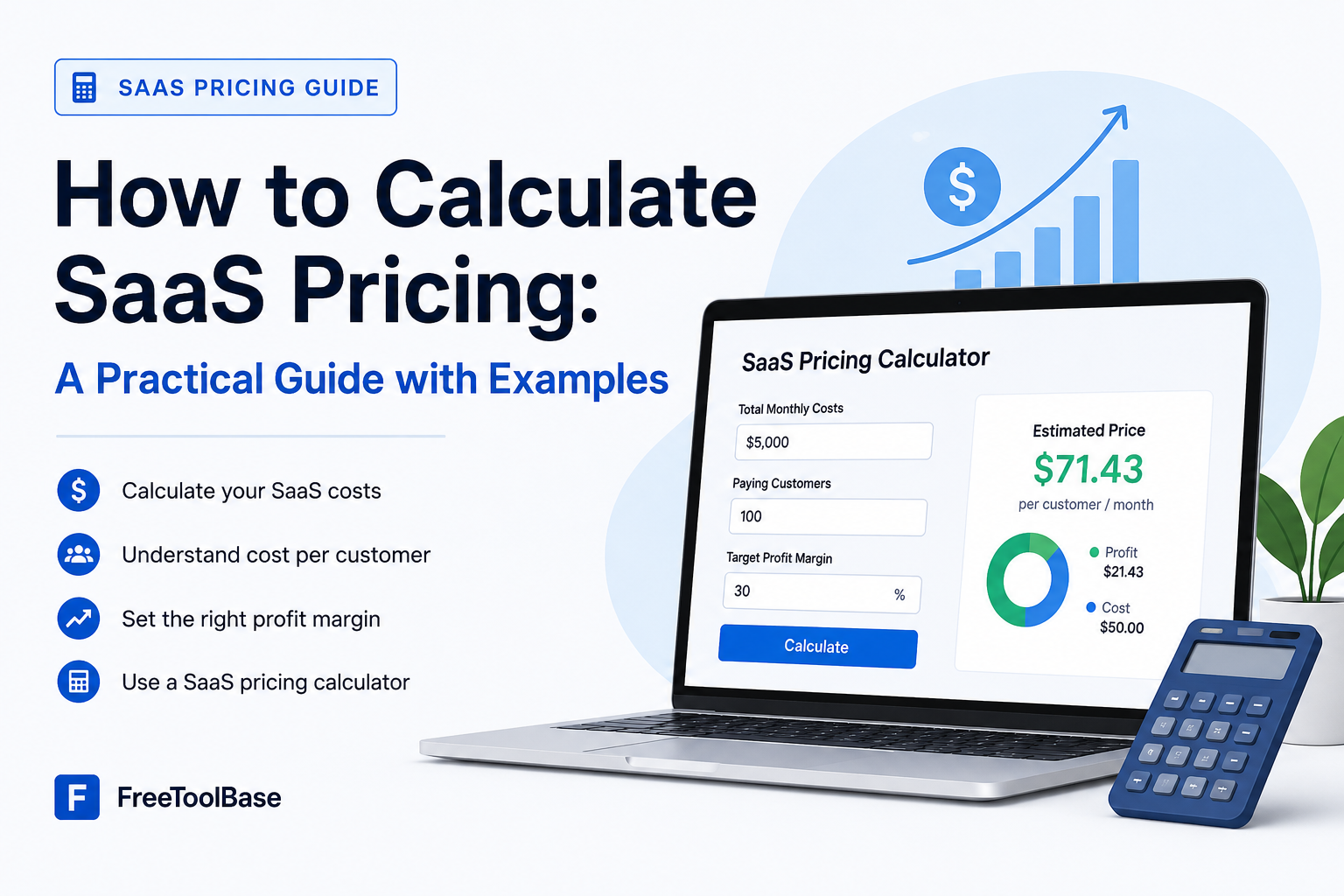
You can use the SaaS Pricing Calculator to explore this estimate.
The calculator asks for three main inputs:
1. Enter Total Monthly Costs
Add your estimated monthly operating expenses.
Include the costs relevant to running your SaaS business, such as hosting, software services, development, maintenance, and customer support.
Use a consistent monthly period.
2. Enter Paying Customers
Enter the number of customers currently paying for your software.
Use paying customers rather than total registered users. Free users do not directly contribute subscription revenue unless they generate revenue through another business model.
3. Enter Your Target Profit Margin
Enter the profit margin you want to evaluate.
For example, you might compare different scenarios using a 20%, 30%, or 40% target margin.
4. Calculate and Review the Result
Select the Calculate button to view the estimated per-customer SaaS price and supporting figures.
You can change your inputs to compare different cost, customer-count, and margin scenarios.
The calculator is designed to provide a quick estimate without requiring a spreadsheet or account registration. Its calculations are processed in your browser.
Try the SaaS Pricing Calculator: https://freetoolbase.com/tools/saas-pricing-calculator
Common SaaS Pricing Mistakes to Avoid
Even when you use a SaaS cost calculator, the quality of the result depends on the assumptions you provide.
Watch out for these common mistakes.
1. Ignoring Operating Expenses
Some businesses calculate pricing using hosting costs alone.
This can produce an unrealistic estimate because development, maintenance, customer support, software services, and other operating expenses also contribute to the cost of running a product.
Build a complete cost picture before deciding on a price.
2. Confusing Profit Margin with Markup
Margin and markup are not interchangeable.
Margin measures profit as a percentage of selling price, while markup measures the increase over cost.
Using the wrong calculation can result in a price that does not achieve your intended margin.
3. Counting Free Users as Paying Customers
A SaaS product may have thousands of registered users but only a small percentage of paying subscribers.
If your goal is to estimate the cost per paying customer, use the actual number of paying customers.
4. Forgetting That Costs Change with Usage
Some SaaS expenses remain relatively stable, while others increase as customers use more resources.
For example, a product that processes large amounts of data may experience higher infrastructure costs as usage increases.
Review your costs when your customer base or product usage changes.
5. Setting Prices Without Understanding Customer Value
A cost-based calculation helps you understand the financial requirements of your business, but it does not measure the value customers receive.
A product that saves customers significant time or money may justify a different price from a product offering similar operating costs but less customer value.
Consider customer needs, willingness to pay, and competing alternatives before finalizing your pricing.
6. Never Reviewing Your Pricing
Your original pricing assumptions may become outdated as your business grows.
Review your subscription prices when you introduce new features, change your infrastructure, expand your support team, or experience significant changes in customer acquisition costs.
Cost-Based Pricing vs. Other SaaS Pricing Strategies
A SaaS pricing calculator provides a useful cost-based estimate, but cost-based pricing is only one approach.
Understanding other strategies helps you make a more informed decision.
Cost-Based Pricing
Cost-based pricing starts with the expenses required to operate the product.
You estimate the cost per customer and add a target margin to establish a starting price.
Best suited for: Understanding minimum financial requirements and evaluating whether subscription revenue can support operating costs.
Value-Based Pricing
Value-based pricing focuses on the benefit customers receive from the product.
For example, software that saves a business several hours of manual work each week may provide substantial value beyond its operating cost.
Best suited for: Products with clear business outcomes, productivity improvements, or measurable customer benefits.
Competitor-Based Pricing
Competitor-based pricing considers what similar products charge.
You compare features, subscription limits, target audiences, support, and positioning to understand how your product fits into the market.
Best suited for: Businesses operating in competitive markets where customers compare multiple subscription products.
Usage-Based Pricing
Usage-based pricing charges customers according to their consumption.
A business might charge based on API requests, storage, transactions, processed documents, or other measurable usage.
Best suited for: Products where customer consumption varies significantly.
Choosing the Right Approach
You do not necessarily need to use only one pricing strategy.
Many SaaS businesses combine cost analysis, customer value, competitor research, and usage patterns to develop their final subscription plans.
Use cost calculations to understand your financial position, then evaluate the market before choosing the final price.
Frequently Asked Questions About SaaS Pricing
What is a SaaS pricing calculator?
A SaaS pricing calculator is a tool that helps estimate subscription prices for software businesses. Depending on its features, it may use operating costs, paying customers, and a target profit margin to estimate a sustainable per-customer price.
How do I calculate SaaS pricing?
Start by adding your monthly operating costs. Divide the total by the number of paying customers to estimate the cost per customer. Then apply your target profit margin using a margin-based pricing formula.
What is the formula for SaaS pricing?
A simplified cost-based formula is:
Cost per customer = Total monthly costs ÷ Paying customers
Suggested price = Cost per customer ÷ (1 − Target profit margin)
Convert the target margin into a decimal before using the formula.
How do I estimate SaaS cost per customer?
Divide your total monthly operating expenses by the number of paying customers. For example, if monthly costs are $5,000 and you have 100 paying customers, the average monthly cost per customer is $50.
What should be included in SaaS operating costs?
Common expenses include hosting, infrastructure, software subscriptions, development, maintenance, customer support, marketing, administration, and payment-related fees. Include the expenses relevant to your business and avoid double-counting them.
Is SaaS pricing the same as SaaS cost estimation?
No. SaaS cost estimation focuses on understanding the expenses involved in operating the software. SaaS pricing uses cost information along with factors such as profit margin, customer value, and market demand to determine what customers should pay.
What is a good profit margin for a SaaS business?
There is no single profit margin that works for every SaaS business. The appropriate target depends on operating costs, growth stage, customer acquisition expenses, product development, competition, and business objectives. Treat any target margin as a planning assumption rather than a universal benchmark.
Can I use a SaaS pricing calculator for a new startup?
Yes. A cost-based calculator can help a startup estimate an initial per-customer price using projected monthly expenses, expected paying customers, and a target margin. However, early estimates should be reviewed as actual customer and operating data become available.
Should I include free users when calculating SaaS pricing?
If you are calculating average costs per paying customer, use the number of paying customers. However, free users may still create hosting, support, and infrastructure costs, so include their associated expenses in your total operating cost estimate.
Does a higher number of customers always mean lower SaaS costs per customer?
Not necessarily. Average cost per customer may decrease when fixed expenses are spread across more subscribers. However, additional customers can also increase hosting, support, and infrastructure expenses. The actual effect depends on how your costs change with usage and growth.
Final Thoughts
Calculating SaaS pricing is not simply about choosing a monthly subscription amount. It requires understanding your operating costs, paying customer base, target profit margin, and the value your software delivers.
A cost-based estimate gives you a practical starting point. From there, you can compare different customer and margin scenarios, review competitor pricing, and evaluate what your target audience is willing to pay.
If you want to explore your numbers without building a spreadsheet, try the SaaS Pricing Calculator. Enter your monthly costs, paying customers, and target profit margin to estimate a per-customer subscription price.
Use the result as a starting point for better pricing decisions, then refine your final price using real business and customer data.
Last updated .